
In crisis? 988 call or text 1-833-852-6262 maternal mental health, 24/7maternal, 24/7 911 immediate danger
Asha | AI Ask Asha

Postpartum: the hours between visits

Healthcare must not stop in the doctor's office.

Asha does not diagnose or prescribe. She explains the evidence, cites it, and tells you when to get care today.

Baby blues, postpartum depression, postpartum anxiety and postpartum psychosis are four different conditions with four different levels of urgency. Know which one you are looking at. Then ask Asha, any hour. When it is serious, she says so.

Five questions, no accountBuilt by two physiciansCited on every answer

Which one is this?

Not all postpartum emotional change is the same.

Four conditions get called "the blues". They differ in how common they are, how long they last, and how fast they need care.

Common. Passes on its own.

Baby blues

  • Tearful, irritable, overwhelmed; moods that swing within a single day.
  • Starts in the first days after birth and peaks around day 3 to 5.
  • Fades within about two weeks as sleep and hormones settle.

Call your clinician if it lasts past two weeks, gets worse, or you cannot care for yourself or the baby.

Is this still the blues? Ask Asha

Common. Treatable.

Postpartum depression

  • Low mood, guilt, hopelessness, no pleasure in anything, most of the day, for two weeks or more.
  • Sleep and appetite changes beyond what the baby causes; trouble bonding; doubts about being able to care for the baby.
  • About 1 in 8 mothers. Can begin any time in the first year; most episodes start 4 to 8 weeks after birth.

Call your clinician this week if symptoms have lasted two weeks. Call today if you have any thought of not wanting to be here.

What helps fastest? Ask Asha
Common. Frightening. Treatable.

Postpartum anxiety and intrusive thoughts

  • Constant worry, racing thoughts, a body that will not switch off, panic that comes in waves.
  • Sudden unwanted images of harm coming to the baby. These intrusive thoughts are common and unwanted. Having them does not mean you will act on them.
  • Panic attacks pass, usually within 5 to 7 minutes, and they do not hurt you.

Say the thoughts out loud to your clinician or to 1-833-852-6262. Call today if the thoughts start to feel reasonable, or like instructions instead of intrusions.

Are these thoughts normal? Ask Asha
Rare. A same-day emergency.

Postpartum psychosis

  • About 1 to 2 in every 1,000 births. Usually begins in the first two weeks.
  • Not sleeping for days even when the baby sleeps; confusion; rapid mood swings; seeing or hearing things others do not; beliefs others do not share; a sense that the baby or the family is in danger; thoughts of harming the baby that do not feel foreign.
  • Risk is higher with a personal or family history of bipolar disorder or a prior episode.

Go to the emergency department or call 911. Do not leave the mother alone with the baby while you arrange care. Most women recover fully with treatment.

What do I do tonight? Ask Asha
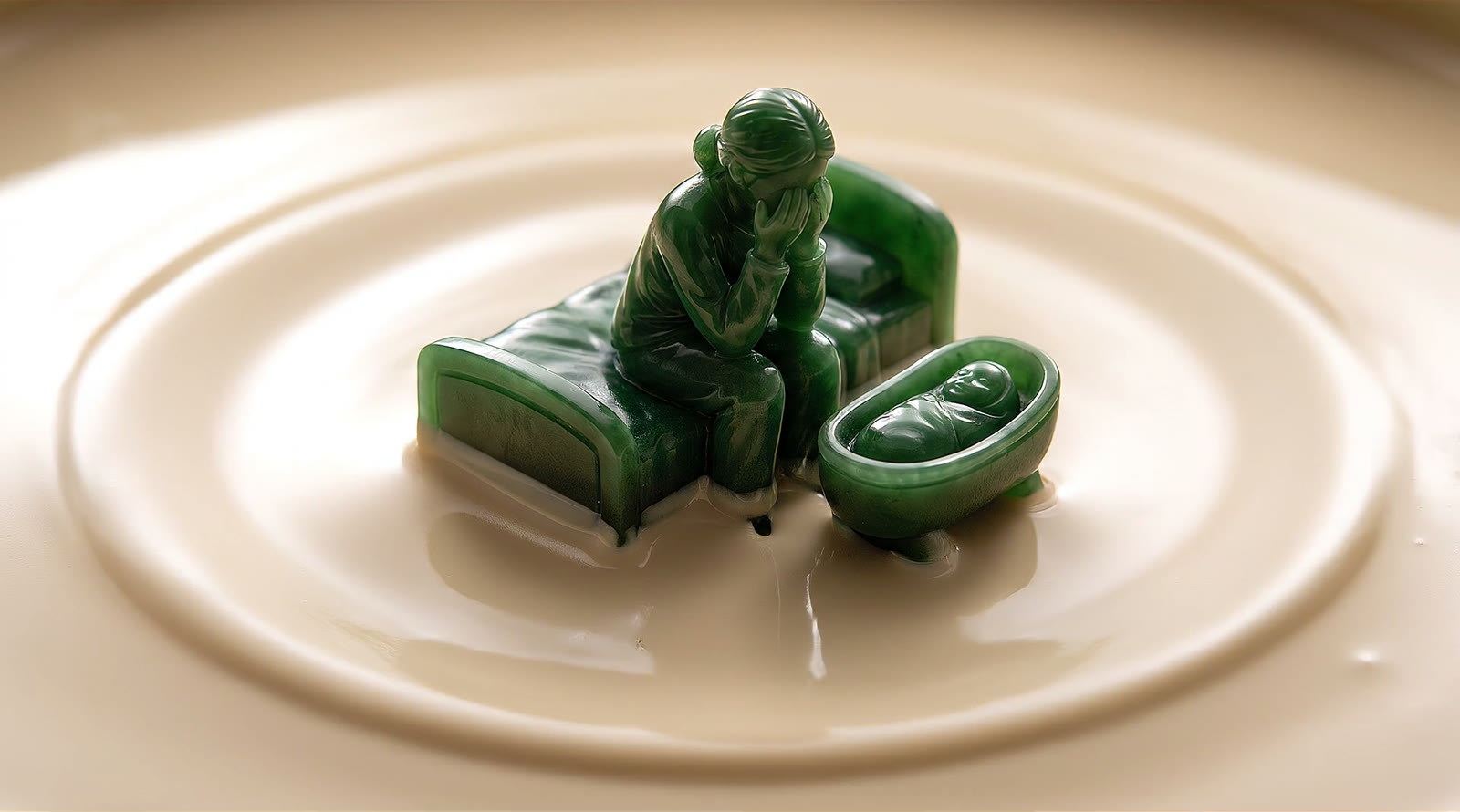
A small carved emerald statuette of a mother sitting on the edge of a bed with her face in her hands, a swaddled infant asleep in a bassinet beside her, standing in a pool of thick ivory liquid.

Blues, depression, or more?

You do not have to name it yourself. Tell Asha what the last week has been like, in your own words. She will tell you what it sounds like, what needs care today, and what can wait until the morning.

Tell Asha about your week

Two things that make every one of these worse

A new medication, and no sleep.

Started an antidepressant and feel worse?

Antidepressants help many mothers. In some, especially those with an undiagnosed bipolar tendency, an antidepressant can trigger agitation, racing thoughts and a sharp drop in sleep. New or worsening insomnia, restlessness, or "wired" energy after a dose change is a warning sign.

  • Call the prescriber the same day.
  • Do not stop the medication on your own. Ask for a same-day plan.

Ask Asha about this

Two nights without sleep

Stress and lack of sleep worsen every one of these conditions, and sleep loss is a trigger for postpartum psychosis in vulnerable women. If a new mother has not slept in two nights, protecting one stretch of 4 to 6 hours of uninterrupted sleep is a medical intervention.

  • Someone else takes the baby for one full stretch. Tonight.
  • Two nights without sleep is a reason to call, on its own.

Ask Asha how to protect sleep

Tonight

What to do before the morning.

If this is you

  • Tell one person the truth about the last week. Tonight, in plain words.
  • Call or text 1-833-852-6262. Free, 24/7, English and Spanish, interpreters in 60 languages. Say the thing you told yourself you would never say.
  • Hand over the baby for one stretch of sleep, 4 to 6 hours, once. Treat it as a prescription.
  • Do not stop a medication on your own. Call the prescriber for a same-day plan.
  • Any thought of harming yourself: call or text 988 now. You are not a bad mother. This is an illness, and it is treatable.

If this is someone you love

You will see the change before anyone else does. Watch for:

  • Not sleeping when the baby sleeps, for more than a night or two.
  • Talking faster than usual, jumping between topics, or saying things that do not add up.
  • New fears about the baby's safety that do not match reality, or saying the baby would be better off without her.
  • A sudden calm after a stretch of agitation. Do not read it as recovery.

Then: stay with her, take over the baby, call 1-833-852-6262 or her clinician. If any emergency sign above is present, go to the emergency department tonight. Remove access to medications and anything else that could be used for harm while you arrange care.

A two-minute check

How have you felt in the past seven days?

Ten questions clinicians use at postpartum visits, the Edinburgh Postnatal Depression Scale. Choose the answer closest to how you have felt over the past 7 days as a whole, rather than only today. Your answers stay on this page. Nothing is stored or sent anywhere.

This is a screening questionnaire. A diagnosis needs a conversation with a clinician; the score is a reason to have it. Whatever the total, one answer matters most: question 10. Any answer other than "Never" means please call someone tonight.

    0 of 10 answered

    Cox JL, Holden JM, Sagovsky R. Detection of postnatal depression: development of the 10-item Edinburgh Postnatal Depression Scale. British Journal of Psychiatry 1987;150:782-786. Reproduced with the citation the authors require. Scores of 10 to 12 suggest possible depression; 13 or more, probable depression; any score above 0 on item 10 calls for a same-day safety conversation regardless of the total.

    Watch

    Three minutes that explain the whole page.

    Our films, and short pieces from clinicians we trust. Nothing plays until you press play.

    Every Question

    1:15. DNAi Systems. No patient appears. The Asha screens are real.

    The questions a new parent asks at 3 a.m., and the answers Asha gives: cited on every answer, in plain language, with a clear line on what needs a clinician today.

    Blues, depression, or more?

    0:12. DNAi Systems. Carved figures.

    The story of this page told in stone: the night, the question, the key.

    Postpartum depression is more than baby blues

    0:59. Mayo Clinic Minute.

    The line between the blues and depression, in a minute.

    A treatment made for postpartum depression

    0:54. Cleveland Clinic.

    On the first medicines developed specifically for postpartum depression. Ask your clinician whether one is right for you.

    Early identification, early treatment

    2:58. UCLA Health, Vital Signs.

    Why the weeks matter, and what screening at the postpartum visit is for.

    Hear Her

    0:42. Centers for Disease Control and Prevention.

    The urgent maternal warning signs in the year after birth, and why a mother's concern deserves to be heard the first time.

    Postpartum recovery, the whole picture

    5:28. Cleveland Clinic.

    Body, sleep, mood: what the first weeks and months usually look like, and when to speak up.

    Rest

    When the baby sleeps and you cannot.

    Guided practices from Asha, five to nineteen minutes, in English and Hindi. They support sleep and calm. They do not treat postpartum depression or psychosis; the lines at the top of this page do.

    Resources

    People to call, places to read, rooms to sit in.

    Talk to someone now

    • 988 Suicide and Crisis LifelineCall or text 988, or chat at 988lifeline.org. 24/7. For you or for someone you are worried about.
    • National Maternal Mental Health HotlineCall or text 1-833-852-6262 (1-833-TLC-MAMA). Free, confidential, 24/7, English and Spanish, interpreters in 60 languages. Partners and family are welcome to call.
    • Postpartum Support International HelpLineCall 1-800-944-4773 (press 1 for Spanish, 2 for English) or text "Help" to 800-944-4773; Spanish text 971-203-7773. Messages returned 8 a.m. to 11 p.m. ET. Support and local referrals; this line is for support and does not handle emergencies.
    • Crisis Text LineText HOME to 741741, any crisis, any time.

    Sit with people who have been there

    • PSI online support meetingsFree weekly video groups, including groups for dads and partners and for postpartum psychosis survivors and their families.
    • Action on Postpartum PsychosisA charity run with women who have recovered. The clearest guides anywhere for partners and families facing psychosis, and a peer forum.
    • MGH Center for Women's Mental HealthThe Massachusetts General Hospital program's plain-language pages on postpartum depression, anxiety and psychosis, and on medications while breastfeeding.

    Read

    The same carved emerald statuette standing upright, the swaddled infant held to her shoulder and a small phone at her chest, beside a teal key rising from the ivory pool.

    Know what is normal. Know what is urgent.

    Asha reads the evidence first and answers in plain language, with the sources. She does not rush you. She will tell you plainly when something needs a clinician today.

    Ask Asha

    Ask Asha

    Tap a question to start, or ask your own.

    Each one opens Asha with the question already sent. Five questions, no account.

    Open Asha

    Asha gives health information and helps you decide what to do next. She does not diagnose, prescribe, or replace your clinician. When it is serious, she says so. In an emergency, call 911 or 988 first.

    Why this page exists

    If a name in the news brought you here, this page was written for you and for the people around a new mother. No claim is made here about any real person, provider, or outcome. What it offers is healthcare between visits: the four postpartum conditions and how they differ, a two-minute check, and who to call tonight. Asha is here any hour, with the sources shown, for the questions that come at 2 a.m.

    About Asha

    Asha is built by DNAi Systems, founded by two physicians. Answers are grounded in a curated medical knowledge base and checked against safety rules before they reach you. Five questions, no account. Then the first month free with a card. Your conversations are private and are never sold. Privacy, safety, pricing.

    Asha | AI

    Your Key to Wellbeing

    askasha.org

    If you are in crisis, call or text 988.

    Blues, depression, or more? Ask Asha